Keeping One Eye out for Nob Street Art and Nobject Trouvé


Showing posts with label Nobart: Origins. Show all posts

Tuesday, November 13

Indiginob


NOBART: ORIGINS 3,

Indiginob
Prof. Belle Ennde


For decades prudish anthropologists have speculated coyly about the purpose and origin of Aboriginal nobart. 

Mountford (1960, p. 81) recalls soberly how “a number of representations of human penes have found their way into various museum collections” while shy Campbell (1921, p. 145) refers to them as “secret articles.. or representations of the male organs of generation”.

 
The skilful indigenes of Australia Have long been producing wonderful dongs from stone, wood, clay and wax, but not telling anyone why. This has naturally unnerved the poor anthropologists who have been digging them up left, right and centre. The sharp eyed Balfour, records Mountford (1960, p. 81) uncovered what he believed to be a natural stone in the shape of a cock, but which the Nobservatory now suspects was an example of nobart left in wait for him by a sniggering artist. 
  
Various lines of speculation have been put forward by the learned Nobservers. Mountford (1960, p. 81) asserts “existing evidence suggests that these phallic objects are probably linked with some mythical beings” having been assured by various antipodean dwellers that a ritual involving gently striking the legendary cock of Borolo-Borolo actually improves ones eyesight, as opposed to the accepted European standard of “if you play with it, you’ll go blind”.  

Sources:

Mountford, C. P. "Phallic Objects of the Australian Aborigines" Man vol. 60 The Royal Anthropological Institute of Great Britain  and Ireland, 1960  http://www.jstor.org/stable/2795984 [04/ 04/ 2012]

Campbell, D "A Description of Certain Phallic Articles of the Australian Aborigines" Man vol. 21 The Royal Anthropological Institute of Great Britain and Ireland, 1921 http://www.jstor.org/stable/2839417 [04/ 04/ 2012]

Saturday, February 18

The Sole to Pole Ratio: Early Beginnings

Fig. 1

NOBART: ORIGINS 2.

The Sole to Pole Ratio: Early Beginnings
Prof. Belle Ennde

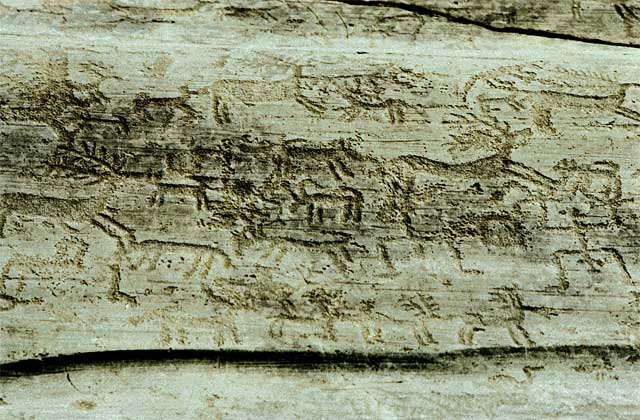
The Valcamonica valley in Northern Italy, nestled between the lakes of Como and Garda, is home to one of Europe's richest collection of rock art. The inviting surfaces of limestone and other calcareous rock were left open to prehistoric people as the ice caps retreated, willing the valleys inhabitants to whip out their tools and start banging away. And naturally, that's what they did. The rock art of the Valcamonica valley consists typically of zoomorphs or anthropomorphs many depicting hunting scenes as can be seen in fig 1. Later images dating from the first metal age also commonly feature tools. In fig 2. we can see one such example. A little figure almost dwarved by his massive tackle, he is out among the other horned animals, waving his weapon about and generally causing havoc. 

The Nobservatory has been speculating wildly and groundbreaking research is currently being conducted in the area. A distinct feature in Valcamonican rock art is the random depiction of footprints, "footsoles", which have stumped experts for decades. Nobservatory researchers believe Valcamonica may be the first known source of the largely mythologised "sole to pole ratio" of phallic measurement. The footprints occur in pairs all over the site and whereas in other European rock art, depictions of footsoles are often easily identified as some sort of directional indicator, the Valcamonica ones are bunged anywhere, willy-nilly as it were. The Nobservatory is now championing the view that they were created as a scale against which a chap could measure his chap, the image in figure two supports this hypothesis. Though a very basic anthropomorphic study, the cock is clearly prominent, and closer comparison between the dimensions of the todger against those of the tootsies reveal a startling Vitruvian ratio. The length of the foot is equal to the breadth of the fully extended knacker sack which bisects the main shaft at precisely the point where another footsole-length from the tip terminates, then another 0.6 of a footsole to where it joins its character. A revelation in what we knew of early-man maths. Or early man-maths. To have been endowed with such a generously, not to mention perfectly proportioned winkie, this character must depict a someone very important in the settlement - the cock of the village, perhaps.
Fig. 2

Sources:


Scarre, C. The Human Past, London (2009)

Paul G. Bahn, J. David Lewis-Williams, Christopher Chippindale, Jarl Nordbladh, Polly Schaafsma, David Frankel "Rock Art"   The Oxford Companion to Archaeology. Brian M. Fagan, ed., Oxford University Press 1996. Oxford Reference Online. Oxford University Press.   The Open University.  http://www.oxfordreference.com/views/ENTRY.html?subview=Main&entry=t136.e0372-s0003 [13 February 2012]

Maretta, A "Digging the Past: 100 years of research on Valcamonica Rock Art" (n.d.) http://www.scribd.com/Alberto%20Marretta/d/19769466-Digging-The-Past-100-years-of-research-on-Valcamonica-rock-art [13 February 2012]

Image: OUA251 Rock Gallery, Open University [13 February 2012]

Thursday, February 9

Hohle Fells Hanger - A Stone Age Wanger


Welcome to the first chapter of Nobart: Origins, a series of little wee articles on early examples of nobart and nobartefacts from around the world dating from prehistoric times - all the way up until the Victorians ruined it all. Damn prudes!


NOBART: ORIGINS 1


Hohle Fels Hanger: A Stone Age Wanger
Prof. Belle Ennde


In 2005 a team of archaeologists led by Nicholas Conard from the University of Tubingen unearthed this 28,000 year old dong from the Hohle Fels cave in S. W. Germany. The siltstone nob was found in 14 separate pieces which when assembled made a magnificent cock of rock. "It's clearly recognisable" Prof. Conard told the BBC.
Wild speculation blazed through the archaeological community: could the 'life size' representation (20x3cm - for those of you who are interested) suggest it was used as a dildo? Or do the marks on the shaft indicate a function - the knapping of flint?
Intensive research conducted by the Nobservatory points towards its use as a tool, skillfully crafted by it's owner to raise a snigger from the lads and wielded with comedy pride down at the old flint mine.

Sources:
http://news.bbc.co.uk/1/hi/4713323.stm

http://www.geo.uni-tuebingen.de/en/work-groups/prehistory-archaeological-sciences/early-prehistory-and-quaternary-ecology.html